
Nasturtium – Tropaeolum majus
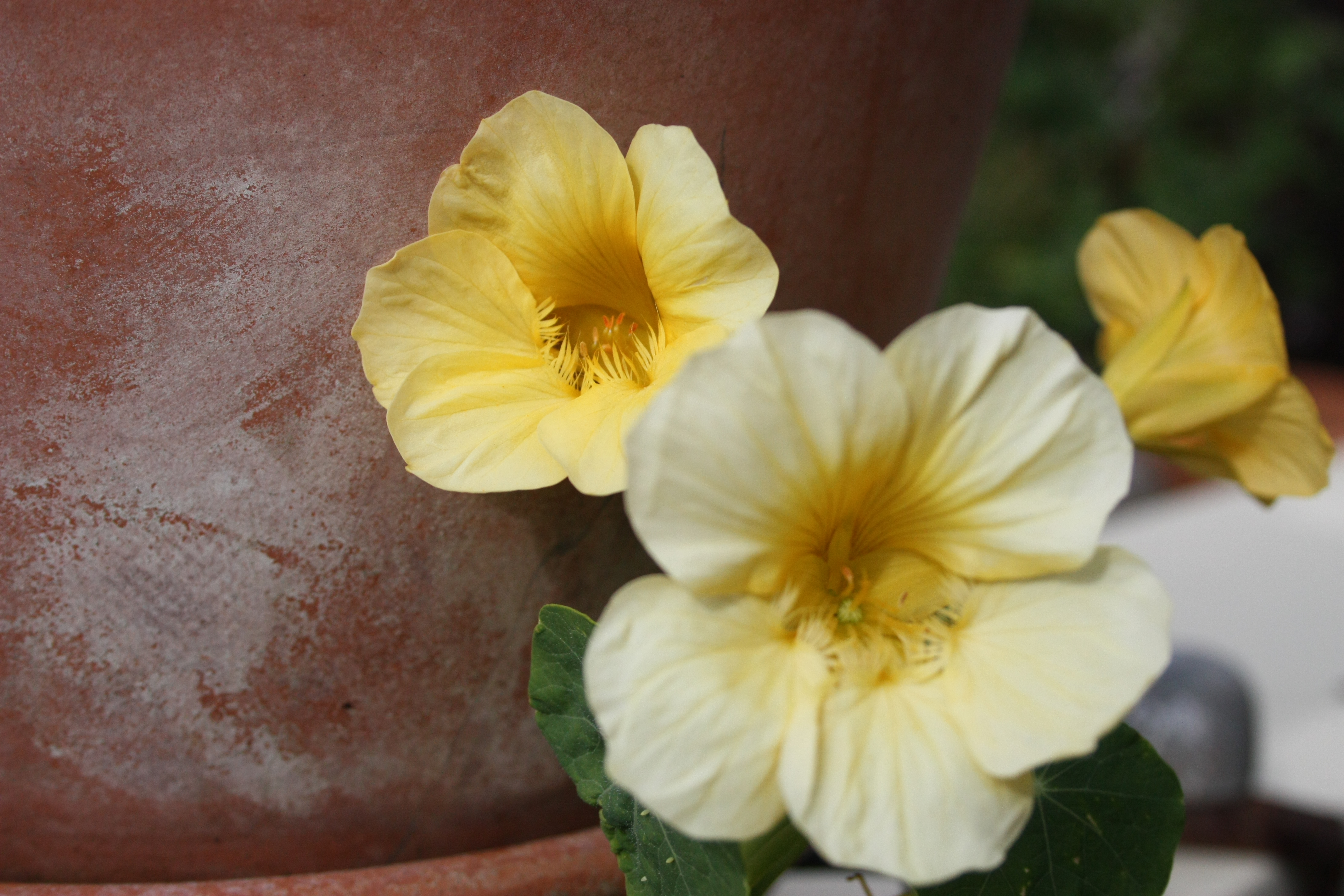
I have often taken the nasturtium for granted as I see them scrambling across the rocks in nearby gardens and tumbling down neglected embankments. They are the seeds you give a child when learning about gardens knowing they will sprout quickly and flower well. Once you have planted a nasturtium in your garden you will find it popping up in the most unlikely places in neglected pockets and it loves poor soil. Just add water and it will grow. No wonder the nasturtium managed to travel around the world. Originating in Central and South America then across the Atlantic with the Spanish and Portuguese explorers in the 16thCentury the nasturtium quickly invaded the gardens of Europe and England where it was used to treat scurvy, then back across the Atlantic to the United States where it was grown in the vegetable garden of Thomas Jefferson at Monticello. In a letter, he mentions using the nasturtiums in his salads.

I have been trying to remember the botanical names of plants but as I was not a student of Latin I resort to visuals to remind me and I bless the imagination of the Swedish botanist, Carl Linnaeus who selected the Greek word tropaion from which the English word trophy stems, because he thought the rounded leaves resembled shields and the curved shape of the flower that of the helmets worn by Trojan warriors. These battle trophies were hung on a pole by the victorious Roman soldiers. The common name of nasturtium was given in recognition of the ‘nose-twisting’ flavour of the mustard seed oils that the plant contains.

Although they aren’t a showy plant as compared to many, the nasturtium has been popular with many painters and artists including Clarice Cliff who adorned her fabulous ceramics with brightly coloured nasturtiums. I wonder how many generations of children have pored over Cicely Mary Barker’s Alphabet Flower Fairy series in which the ‘N’ Fairy is a boy sitting in a nasturtium lower cap using a leaf for an umbrella and shoes adorned with nasturtium seeds. Cressida Campbell an Australian artist has used the nasturtium with its curving trailing lines in her beautiful wood blocks.

Once I started looking seriously at the nasturtiums growing around my neighbourhood I realised that the flowers come in lovely shades of orange, lemon, yellow, salmon and red that contrast against the bright lime green leaves. There are also variegated leaves and dark green almost black leaves that I am on the search for. It is easy to understand their attraction to Monet who planted them at Giverny where they spilled out across the pathways in his garden. I now have them spilling out over the top of my pots and popping up all over the place.

Fortunately, the root system is shallow making them easy to remove as the plant self-seeds easily. It is a fast grower and a very energetic territorial creeper that doesn’t stick to boundaries or fences and I am sure that if I stood still it would cover me. I now have blue plumbago invaded by a yellow flower, and a lemony yellow variety taking over the iris bed. I have draped it up and around a couple of stakes and it is now flowering happily in competition with the tomato bushes that stand beside it. This also takes the pressure off the white gerbera that were being smothered by the profusion of saucer shaped leaves on the stalks which were acting as a living mulch and covering up everything that stood in its path. As I pull it out, I smell the distinctive sweet honey aroma tinged with the spice from the mustard oils.

It is suggested they are a good plant for companion planting with roses and vegetables possibly because of their spicy oils which are said to repel aphids however, looking at the number of aphids on my rose stalks I am not sure I could grow sufficient nasturtiums to deter these voracious insects.
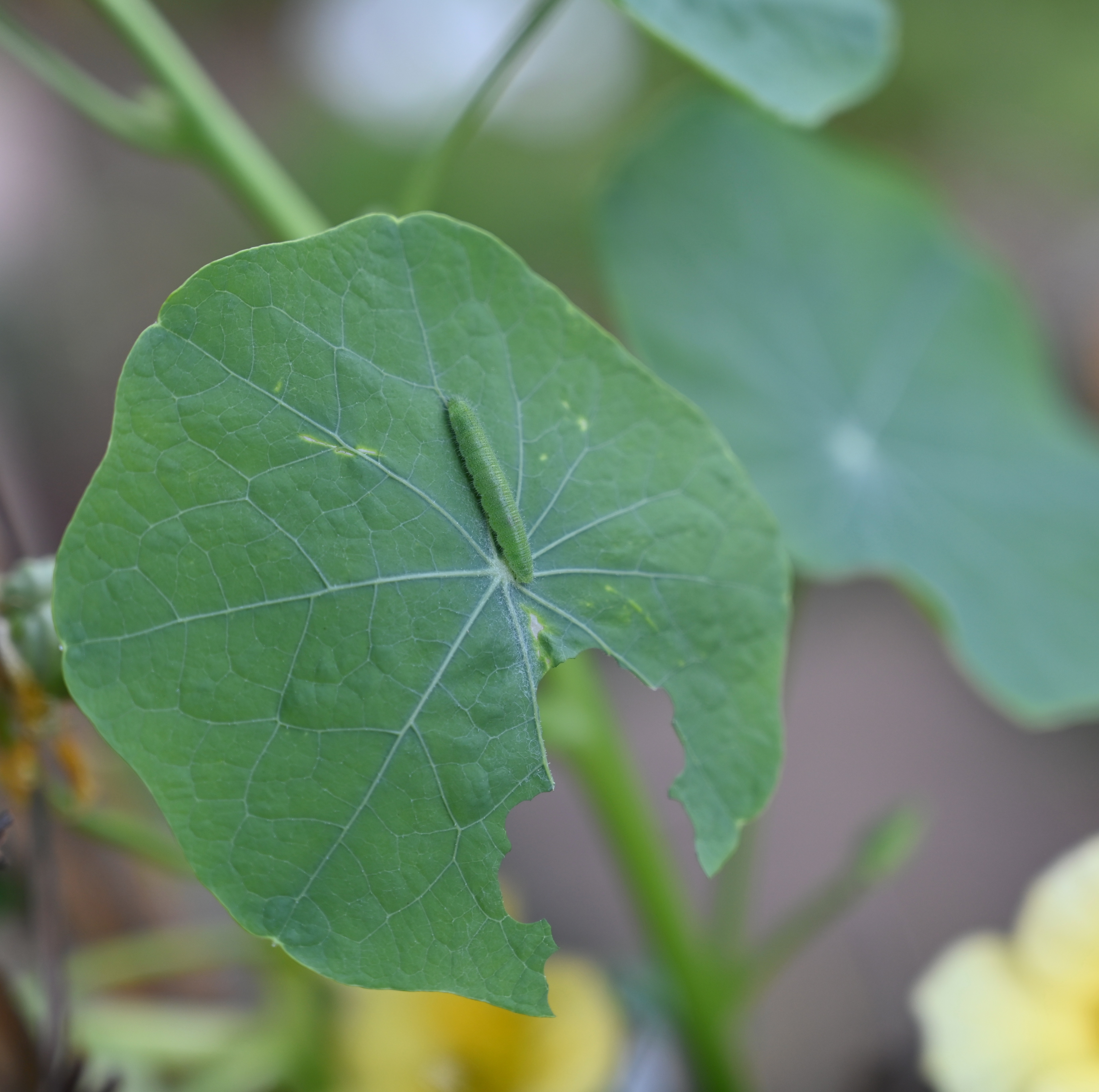
They don’t seem to have too many pests although I have seen the White Cabbage butterfly hovering around and did spy a beautiful green caterpillar on one leaf.
On the plus side the flowers do attract hoverflies and bees so I hope someone nearby is producing nasturtium flavoured honey.

They are also a very useful edible plant with the seeds, the leaves and the flowers all being used in my kitchen. I am lucky to garden in the sub-tropics where the nasturtium flowers prolifically even in winter. The leaves and flowers are a rich source of nutrients including Vitamin C and natural antibiotics. I have used the flowers to add gorgeous colour to a simple green salad, the petals have a gentle buttery flavour.

I have stuffed the flowers and small leaves with goats’ cheese mixed with fresh herbs for a delicious hors d’oeuvre and I am going to collect the seeds which can be pickled in vinegar and substituted for capers.

Once you start looking there are lots of recipes that use nasturtiums including in sauces, pesto and in muffins as well as in beauty products including Hair Tonics. This ordinary fragile plant has opened up an entirely new world for me.

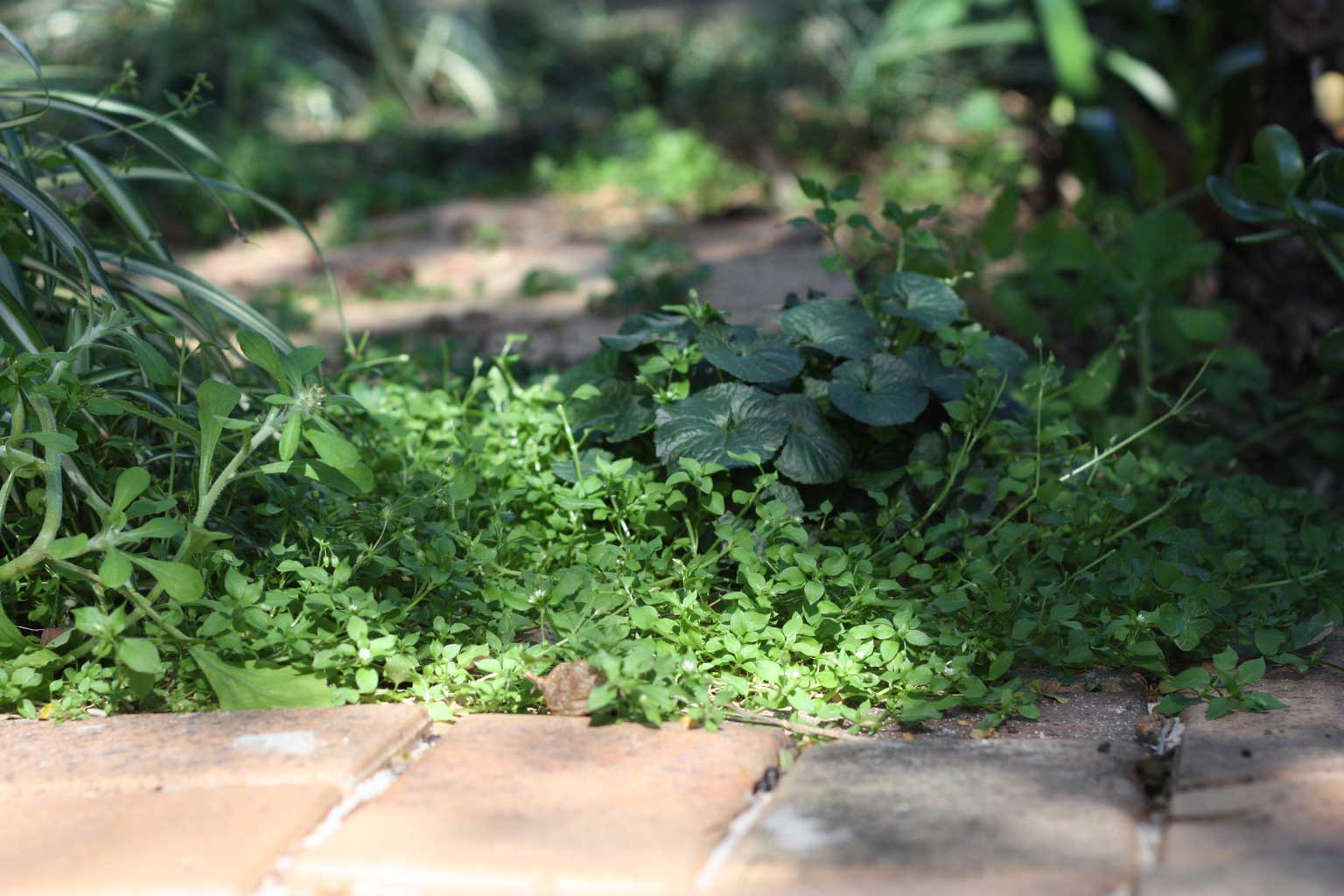 This last unknown is appearing in my hanging baskets, tumbling over my walls, and in between the pavers.
  Initially I nurtured it with water and seaweed emulsion only to have an explosion of growth suddenly start taking over the beds. Suspicion started to creep into my mind as nothing I have planted grows that quickly and I have now realised I am battling a worthy foe. Chickweed!
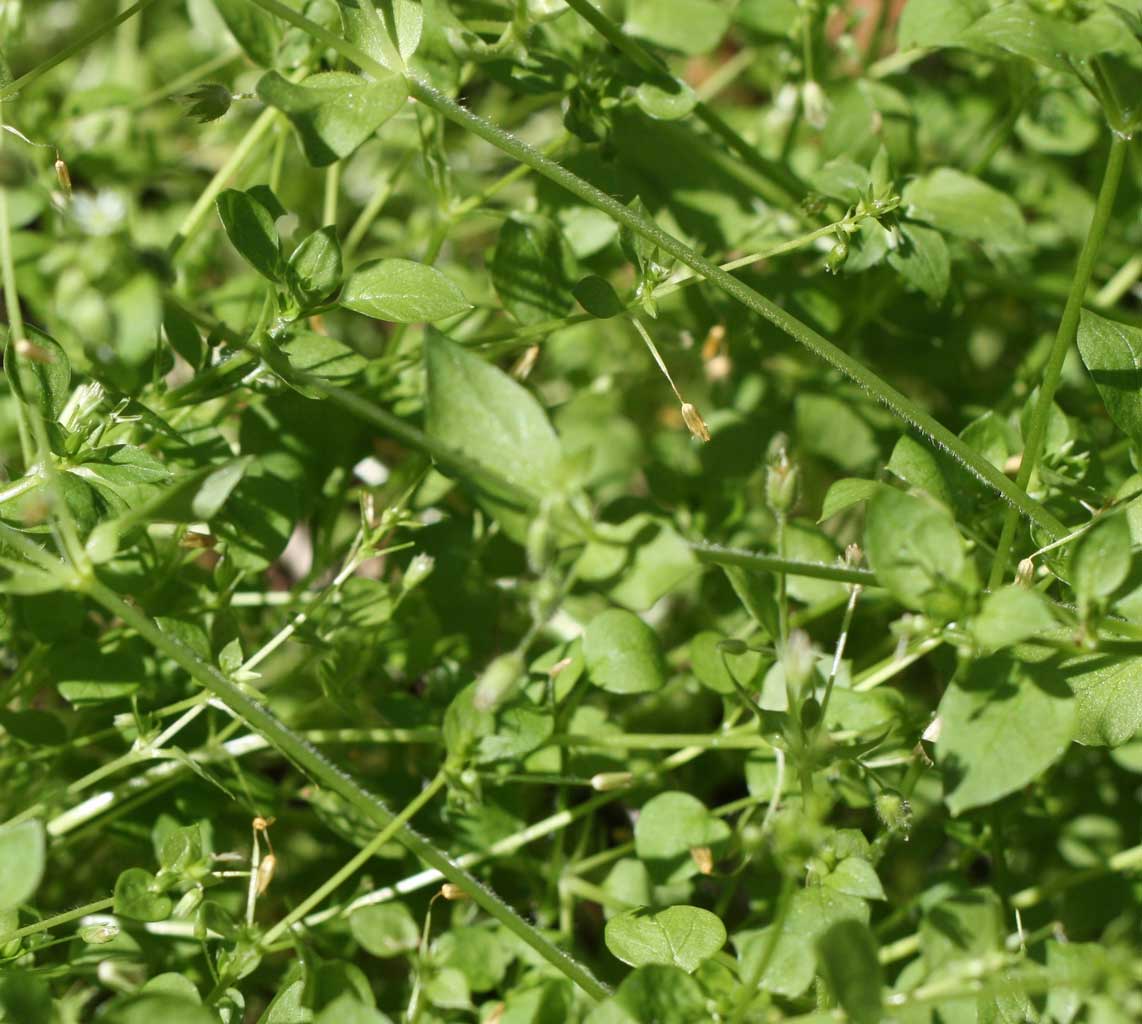 I have been on my hands and knees reaching under the roses, through the hydrangea, around the olive trees and across the brick pavers removing this fragile but tenacious weed and throwing it into the bin. Fortunately it is relatively easy to pull out but little bits still litter the garden probably preparing to haunt me in another 12 months. I have been muttering to myself, asking where did it come from. As I have been growing my own mulch (which is another story) for the past 12 months I doubted that it was from the bag of sugar cane I had used 12 months ago.
  I didn’t remain in ignorance for long as crouching under the olives I glanced across my neighbour’s neglected backyard and saw a glorious carpet of light green starting right next to my fence. The ground is covered in a tangled mass of stalks, leaves and flowers.Now I had found my source; Stellaria media commonly known as chickweed, winter weed, bindweed, satin flower, satin-flower, starweed, starwort, stitchwort, tongue grass and white bird’s eye.
 I am trying to make my garden as sustainable as possible and I hate throwing plant material out but this weed had gone to seed and I am not going to put it into the compost bin. As I threw the fourth bag away I started to wonder if it was edible. The name surely has to be a clue; I mean chickweed? I grabbed a couple of handfuls and walked through the forest to see if my son’s chooks would eat it. No problems there and they are still alive as I write. Chickweed is easy to identify with its frill of fine hairs running up one side of its stalk, changing sides at a leaf juncture.
 My father, curious about my frenetic gardening activity, wandered down to see what I was doing. I explained that having identified that this weed was not toxic to humans I was going to put some in our salad. Curious to see what it tasted like he reached down and picked off a few leaves to nibble on.
 It now definitely has a place in my diet both in salads, as an infusion and in pesto. It is also said to be useful as a poultice or tincture for skin irritations and helpful in treating obesity not that this is a problem in our household. I am really quite excited about identifying this plant and am now keen to see what else I can use from my garden’s supply of edible weeds.




 lorikeetlady